
Gallia County Release Date Meanings
A projected date is a calculation, not a promise. In the Ohio prison system, the public label is Expected Release Date/Parole Eligibility Date. Those two ideas share one field even though they can mean very different things. A projected release date estimates when a prison term may end under the sentence and credit rules. A parole eligibility date marks when a person may be considered for parole. Eligibility does not mean release was granted. The latest custody status, sentence details, hearing result, and release-detail fields must all be read together.
An actual release date records an event that has already happened. For Gallia County Jail, JDS may show a populated Release Date, but that field does not state the time, authority, reason, destination, or receiving agency. Leaving county custody can mean community release, transfer to ODRC, extradition, or pickup by another agency. The signed court entry explains the legal action, while the jail release transaction explains the physical exit. Neither record should be forced to answer the other record's job.
A pretrial detainee usually has no sentence-based date to calculate. Bond may be set, modified, posted, or held up by another charge. A dismissed charge may sit beside an open charge. For that reason, a bail amount or one favorable disposition is not an exit date. Gallipolis Municipal Court handles misdemeanors and preliminary felony proceedings, while a bound-over felony continues in Common Pleas. The physical release follows only after all active authority and holds are resolved.
Find a Gallia Release Date
Start with the last known custodian. The Gallia County sheriff's current-inmate link leads to JDS for a county-jail stay. ODRC is the correct source after a state-prison commitment. A federal sentence uses the federal system, not the county or state portal. This boundary matters because a person sentenced in Gallia County may be housed in another Ohio county or in an ODRC institution far from Gallia.
- Identify the custody class. Decide whether the person is awaiting court, serving a Gallia County Jail sentence, committed to ODRC, or held by another jurisdiction.
- Check the matching record. Read JDS and the local docket for county custody. Search the ODRC Offender Search for a state-prison term.
- Match the person. Compare birth date, Jail ID, SID, ODRC number, booking or admission date, docket, offense, and committing county.
- Read status before date. In ODRC, compare status, Parole or Release Detail, POA/PRD, hearing result, and supervision information with the combined date field.
- Confirm the calculation. Use the court journal and the jail or ODRC record office when a field conflicts, is blank, or lacks a clear release basis.
For an ordinary Gallia jail sentence, the ODRC date field is not a calculator. Use the sentencing entry, legally credited confinement, and the jail's computed record. The Gallia Common Pleas court links lead to eAccess for felony journal entries. Municipal records cover local misdemeanor and early felony stages, but the court warns its web data may lag. A court order may appear before the jail finishes physical processing.
When the exact county date or time matters, ask the sheriff for the existing booking sheet and release transaction or log entry. Give the full name, aliases, birth date if known, Jail ID or SID, and a narrow date range. Ask for release date and time, release type or authority, and receiving agency or destination if those fields were recorded. Ohio law does not require the office to create a custom forecast from facts that are not already in a record.
Note: A missing JDS match may mean transfer, overflow placement, short-term city custody, or a search mismatch rather than release.
Read Gallia Release Date Fields
ODRC provides more than one date and status clue. Its official field definitions explain the combined expected or parole date, POA and PRD abbreviations, and release-detail field. A date should be captured with the page's current status and observation date. ODRC warns that its summary may not contain all sentencing information, so the Gallia Common Pleas docket remains important when a judicial-release or sentencing entry changes the result.
| Field | How to read it |
|---|---|
| Status | Shows whether ODRC reports incarceration, release, APA supervision, or another state status. It receives priority over an old institution field. |
| Expected Release Date/Parole Eligibility Date | May be a projected end point or a date for parole consideration. It is not proof of an actual exit. |
| POA/PRD Date | POA means parole on or after. PRD means projected release date. Sentence type gives the abbreviation its meaning. |
| Parole or Release Detail | Supplies event detail for a released or paroled person. ODRC says an incarcerated person has no such entry. |
| Supervision Start and APA Office | Can corroborate a transition from prison to state supervision, but not the person's current physical location. |
| Jail-time Credit | Shows confinement credited toward a state term. A correction can move the projected date. |
The manifest image below comes from the same official definitions source and shows why the exact labels matter. Open the ODRC definitions page for the current text.
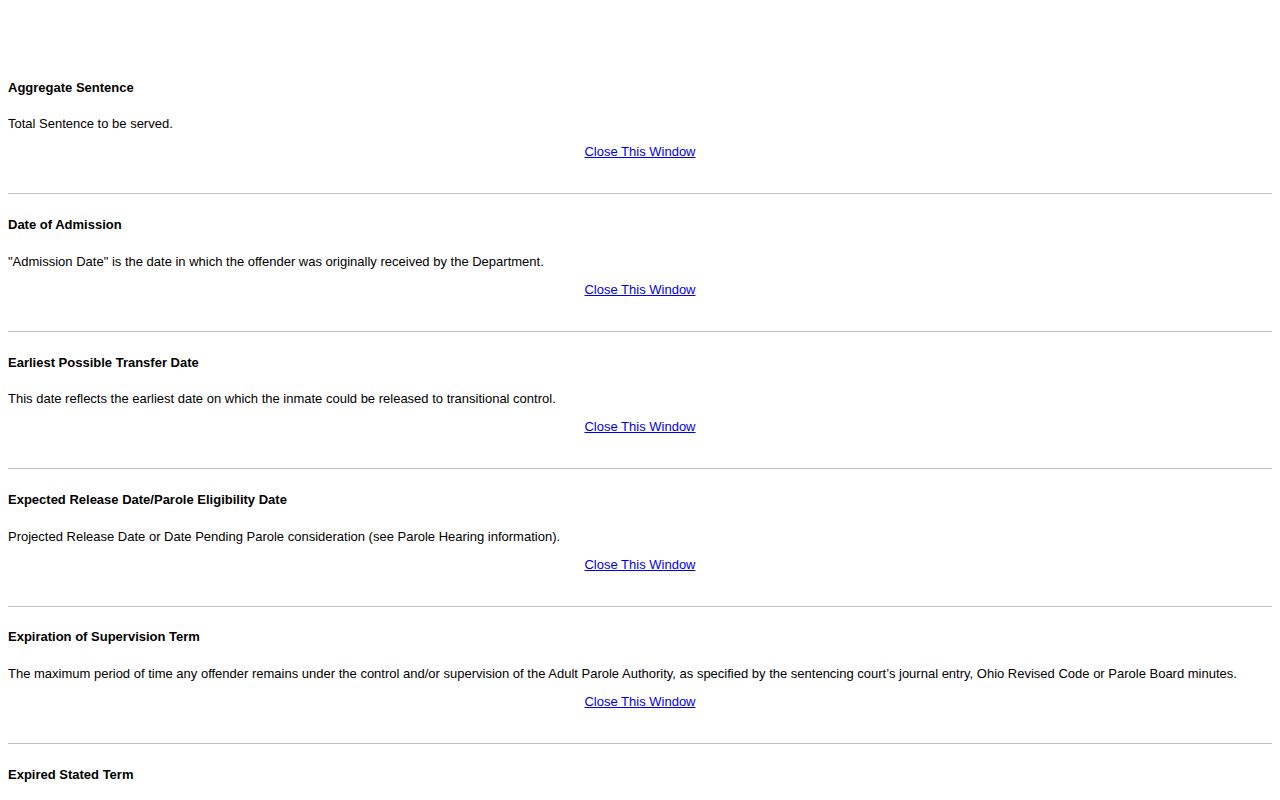
The field guide supports a careful reading: the date, release detail, and live status work as a set, not as interchangeable answers.
Gallia County Release Credit Rules
Ohio earned credit can affect an eligible ODRC term, but it is not automatic good time for every sentence. ORC 2967.194, for confinement on and after April 4, 2024, allows provisional credit for productive participation and qualifying completion. Ordinary participation may produce one or five days per completed month. A second qualifying activity may add days. The aggregate credit described in division (A)(2) is capped at fifteen percent of the stated prison term.
Credit remains tied to eligibility, successful work, and conduct. ODRC may deny or withdraw provisional credit after rule violations, then finalizes it through administrative review. Mandatory or nonreducible terms and several offense or sentence classes are excluded or limited. The statute also provides a separate achievement-based credit for certain qualifying programs, subject to its own limits and exclusions. A person-specific estimate therefore needs the sentence structure and ODRC's actual credit record.
Older confinement may fall under ORC 2967.193, while the transition rule appears in the newer law. OAC 5120-2-06 provides administrative detail. Non-life indefinite terms under ORC 2967.271 add another distinction: the minimum or presumptive point may not be the actual release date because statutory proceedings can continue custody up to the judicial maximum.
None of these state rules should be used to guess an ordinary Gallia County Jail date. No Gallia-specific public good-time formula, weekend-release implementation, or automated local sentence calculator was found in the official sources reviewed. The local sentence is verified through the court entry and jail calculation.
Why Gallia Release Dates Change
A projected date can move in either direction. Some causes are arithmetic, while others arise from a new order or another agency's claim. Keep a copy of the source date and the day it was checked. That small step makes it possible to explain why a later record differs instead of treating either record as false.
| Change | Effect on the date |
|---|---|
| Jail-time credit correction | A corrected amount of credited confinement changes the remaining term. |
| Earned credit | Eligible progress may reduce time, while denial or withdrawal may restore time to the calculation. |
| Consecutive or mandatory terms | Sentence structure can delay the operative date and limit reductions. |
| Later court entry | Judicial release, a corrected sentence, or another signed order may supersede an earlier projection. |
| Parole Board action | A grant, continuation, denial, or later review affects parole-based timing. Eligibility alone changes nothing. |
| Detainer or transfer | Gallia or ODRC custody may end while another county, state, federal, or immigration custodian takes control. |
| Indefinite-term process | A presumptive point may not be the final day under the governing non-life indefinite-term procedure. |
ODRC's public judicial-release example illustrates the problem. The record reports release while still displaying the combined expected or parole date. View the official ODRC example before treating any single field as decisive.
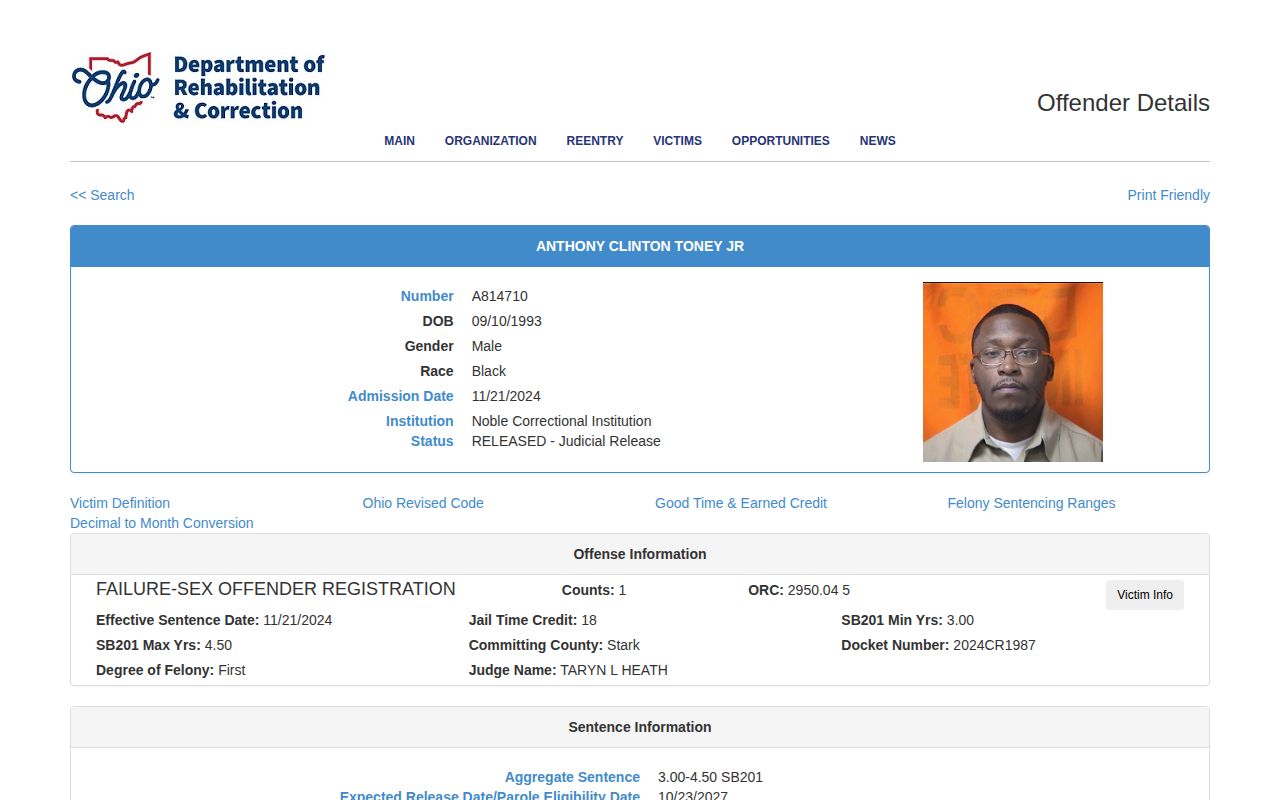
The example confirms why status and Parole or Release Detail outrank a date shown without context.
Note: A detainer can end one agency's custody on schedule while preventing a community release at that time.
Gallia Release Date 85 Percent Myth
The common claim that every Ohio prisoner serves eighty-five percent is too broad. The figure comes from the fifteen-percent cap on one ordinary credit category in the current earned-credit statute. A cap is not a guaranteed award. Credit is provisional and depends on the person's legal eligibility, program participation, completion, conduct, sentence, and ODRC review. Several offense and sentence types are excluded or restricted.
This distinction is especially important for a Gallia County case. A local jail sentence is not calculated by applying the ODRC cap. An older state-prison term may fall under a prior statute. A parole-eligible sentence uses a consideration date, not a fixed credit formula, and a Reagan Tokes non-life indefinite term has its own statutory process. The only sound estimate is the one derived from the governing sentence and the responsible custodian's current record.
Do not subtract fifteen percent from a sentence and publish the result as a release day. That shortcut ignores mandatory time, jail credit, consecutive terms, later court orders, earned-credit performance, and Board action. Ask ODRC or the Gallia court to explain the existing calculation when the public fields do not reconcile.
Confirm a Gallia Release Date
For county custody, reconcile JDS with the relevant court and the sheriff's release transaction. For state custody, begin with ODRC status and release detail, then match the Gallia Common Pleas docket. A projected date should always be stated with its source and observation date. If the date is tied to parole, read the actual Board result or official minute instead of treating a hearing month as approval.
Notifications can add a prompt custody-event signal. Ohio VINE may report an agency's release event, but it does not decide whether another custodian took control. The Gallia County VINE inmate check explains the person-specific alert path. For broader jail and court verification, the Gallia County released-inmate search follows the county, state, court, and transfer channels in order.
When time is critical, call the office that holds the record. Gallia County Jail lists 740-441-2054. The sheriff's records request route also accepts the online form, email, phone, mail, or an in-person request. Ask for an existing record and a narrow date range. No fixed local response time or release-record fee is published, so request a cost estimate and do not promise same-day production.