
Gallia Parole Versus Probation
Parole and probation both place rules on a person outside a locked facility, but they begin in different ways. In Gallia County, parole follows release from an Ohio prison for a sentence that permits parole. Post-release control is another state supervision term that can follow prison. Both are administered through the Ohio Department of Rehabilitation and Correction's Adult Parole Authority. Probation, called community control in many Ohio court entries, is imposed by a court and may follow a county-jail release without any state-prison stay.
The distinction controls where to verify a record. An ODRC Offender Search result may show APA supervision, its start, its period, and an assigned APA office. A Gallia Common Pleas docket may instead show community control, modification, revocation, or termination. An absent APA result does not disprove local probation.
| Supervision type | Who orders it | Best public check |
|---|---|---|
| Parole | Ohio Parole Board after an eligible prison term | ODRC status, release detail, Board result or minute |
| Post-release control | Ohio law and the prison sentence | ODRC APA status, start date, period, and APA office |
| Probation or community control | Gallia Common Pleas or another sentencing court | Public court journal and the correct probation office |
- Parole
- Conditional release from an eligible prison term under state supervision.
- Community control
- An Ohio court sentence served under local rules outside prison, often called probation.
- Discharge
- The formal end of a term of supervision, not merely a release from custody.
- Absconder
- A person whom the supervising agency alleges has stopped reporting and whose location is not known to that agency.
Verify Gallia Post-Release Supervision
Start with the last custodian and the sentencing court. A Gallia County Jail release can lead to local community control. A person committed to ODRC may later leave prison on parole, post-release control, or judicial release. The same name can appear in more than one record, so compare birth date, ODRC number, docket, offense, and committing county before relying on a match.
- Search ODRC by surname, then add the first name or offender number. Repeat with the status filter set to APA Supervision.
- Open the person detail. Read the current status with the Parole or Release Detail, supervision start, supervision period, and APA office.
- Open Gallia Common Pleas eAccess and match the docket. Look for sentencing, judicial release, community-control, revocation, and termination entries.
- If the sentence imposed local probation, use the public docket first and then contact the Gallia Common Pleas probation office for the correct office route.
- When a short status label conflicts with a signed court entry, request the underlying journal entry or agency record instead of guessing.
ODRC uses Residential County as a filter for APA and violator records. Gallia in that field is a last-recorded county, not a live location. The County of Committment field, spelled that way by the portal, identifies the county tied to the state sentence. It does not say where the person now lives or where ODRC housed the person.
A person shown as Released is not necessarily under APA supervision. A person shown as APA Supervision has left prison custody but remains under Department supervision. A judicial-release record can still display the combined Expected Release Date/Parole Eligibility Date, so that field cannot override the current status. Read the status, release detail, supervision dates, and court journal as a set.
Gallia Supervision Has Two Paths
Gallia County has no single office that answers every post-release supervision question. The local Common Pleas probation department handles court community control. ODRC details can identify an APA office for parole or post-release control. This split is a distinctive local routing point: a person released from Gallia County Jail may report to the local court office and have no APA status at all.
Gallia Common Pleas Probation
18 Locust Street
Gallipolis, OH 45631
740-446-4612
Fax: 740-441-2051
The directory identifies Chief Michael Smith at extension 1810, Assistant Chief Melissa Hall at 1812, and officers Mykal Haner at 1813, Abigail Lowe at 1816, and Matt Moleski at 1811. These contacts help locate the correct office. They do not make confidential case-management files public. Ask for a public journal entry, order, or termination record by docket when possible.
Note: Use the ODRC-listed APA office for state supervision and the Gallia court directory for local community control.
Gallia Supervision Violator Records
Conditions vary by sentence and order. Common public records may reflect reporting duties, a supervision period, an APA office, or a court response to an alleged violation. A breach does not always produce the same result. The supervising authority may investigate, change conditions, file a violation, seek a warrant, or return the matter to a court or the state process. Ohio Revised Code 2967.15 provides the state framework for parole and related violations.
ODRC provides both a Violators at Large search status and a dedicated Parole Violators at Large listing. That label means ODRC alleges the person absconded supervision and does not know the person's present location. A displayed residential county or address is historical, not a verified current place.
The official statewide violator page shows the public search route used for this status.
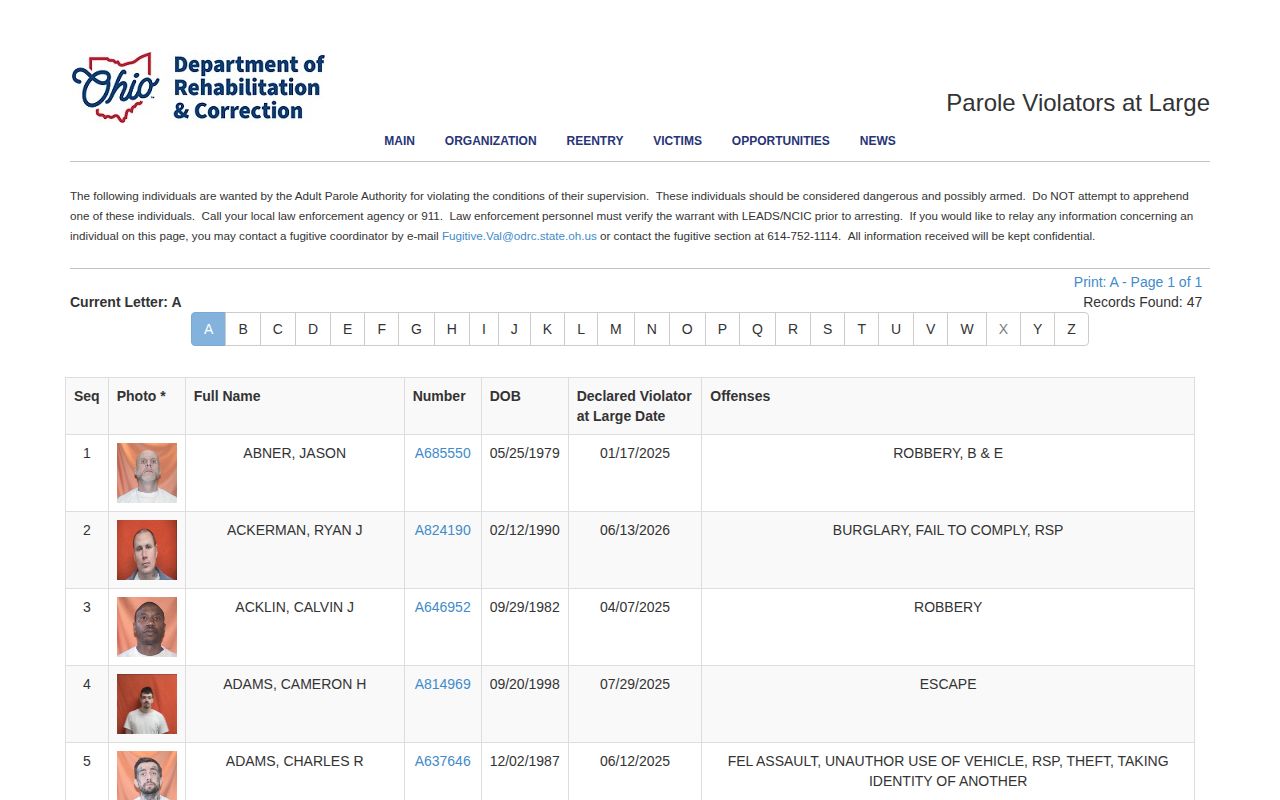
Its statewide scope is why the person detail and identifiers must be matched before connecting a result to Gallia County.
A hearing or review result also needs care. The ODRC person page may state the latest hearing type and a short result, while official Board minutes carry the recorded decision. A result marked continued means the matter was carried forward, not granted or denied. Under Ohio Administrative Code 5120:1-1-11, hearing decisions are recorded in official minutes. Ask for that minute or order when a short portal label does not answer whether release or supervision changed.
Parole eligibility also is not release. It means the person may be considered under the applicable sentence. The Board weighs the case under its legal rules, and no one field guarantees an outcome. A future hearing month or eligibility date must not be recast as a firm release date.
Gallia Release Reentry Contact
Sheriff Matt Champlin's Gallia County Jail staff directory names Elisha Biland as Re-Entry Specialist. The public jail page does not state a service menu, eligibility rules, enrollment process, or hours. That limits what can be promised. A person nearing release, or someone helping after release, should contact the jail and ask what help is currently offered and who qualifies.
This local role is tied to the jail, not to a finding that a person is on parole or probation. Supervision must still be verified through the court or ODRC. The Gallia County Jail page is the official source for the staff listing and current jail contact information.
Note: The presence of a re-entry specialist does not establish that any specific benefit, ride, placement, or program is available.
Property After Gallia Release
Post-release needs can begin before an office visit. Gallia's jail rules say original incoming mail is scanned for viewing and stored with personal property. Remaining property is returned against a signature at release. If it is not collected after release, transport, or extradition, the handbook sets a fourteen-day pickup limit.
An authorized third party may use the property window Monday through Friday from 8 a.m. to 4 p.m. A written, detailed complaint about returned property is answered within 72 hours, excluding weekends and holidays. Commissary funds, less applicable fees, are returned by debit card. These procedures can help document the close of jail custody, but the property receipt is not a substitute for a release transaction or supervision record.
Gallia Supervision Discharge Records
Supervision ends through a formal state or court action. For APA supervision, read the ODRC status with the displayed supervision dates and release detail. For community control, locate the Gallia court journal entry that terminates, completes, revokes, or changes the order. A date that was once projected does not prove discharge occurred.
Ohio public-records law, ORC 149.43, supports requests for responsive, nonexempt records. It does not make every parole, probation, community-control, or post-release-control file open. Ask for the public order, minute, status record, or nonexempt portion. When exact release history is also needed, the Gallia County released-inmate search and records path explains how the jail, court, and receiving system fit together.
An ODRC record can show APA Supervision even though prison custody ended. A court docket can show community control after a county-jail exit. Discharge is the endpoint of that supervision, not another word for leaving the jail.
Keep a copy of the dated result and the matching docket entry so later status changes can be traced to their source.
For a local case, search the chronological Gallia Common Pleas docket for an entry that states the court's action. A favorable entry on one charge may not end another charge, hold, or state term. For a state case, compare the ODRC number and Gallia docket before requesting a Board or central record. This prevents a same-name record or an old projected date from being mistaken for the actual discharge.